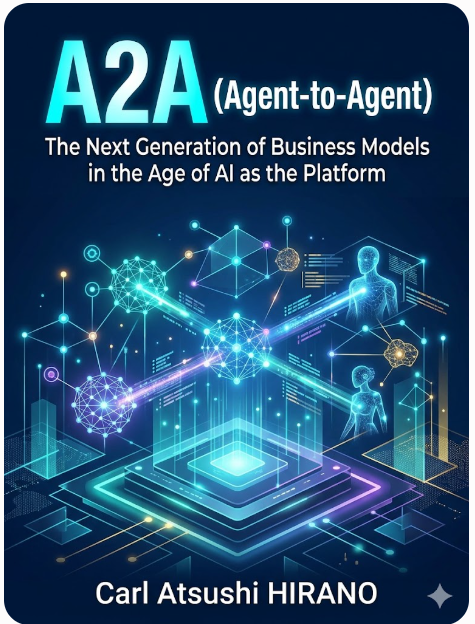

Our book Platform Strategy (Toyo Keizai Inc.), which became a bestseller with endorsements from Kenichi Ohmae and Rakuten Hiroshi Mikitani, was first published in August 2010.
Sixteen years have passed since then.
During this period, the world’s largest companies by market capitalization have been dominated by firms built upon platform-based business models—companies such as Google, Apple, Facebook, Amazon, and Microsoft.
However, with the emergence of AI Agents in 2026, platform businesses now face an existential threat.
The reason is simple: the traditional platform’s core value proposition may soon be rendered obsolete by AI itself.
This series presents ideas from a forthcoming book and explores how the rise of AI Agents could fundamentally transform—and in many cases dismantle—the platform economy that has dominated the digital era.
Part I: The Collapse of Platforms
Chapter 1: The Day Platforms Disappear — The End of Search and Comparison Businesses
1. A Morning in an Ordinary Future
It is a Thursday morning sometime in the late 2020s.
You are a busy executive rushing between meetings in a Tokyo office. Yet without opening a single app on your smartphone, all arrangements for an unexpected business trip next week have already been completed.
More precisely, it was not you who completed them.
Your personal AI Agent did.
You simply said:
“Two nights in Kyoto starting next Wednesday. Budget around ¥50,000 per night. I need a quiet hotel suitable for work, preferably with a sauna. Travel by Shinkansen.”
A few seconds later, your AI Agent responds:
“A luxury hotel near Oike Street has been reserved at ¥48,000 per night. Your preferred firm pillow and a quiet low-floor room have been requested. Round-trip Shinkansen tickets have been secured with Mt. Fuji-view seats and synchronized with your calendar.”
Throughout this process, you never opened Booking.com.
You never visited Expedia.
You never checked Rakuten Travel.
You never even looked at Google Travel.
You did not scroll through hundreds of hotel photos.
You were not pressured by pop-ups announcing that “three people are viewing this room right now.”
You did not spend hours reading unreliable reviews written by strangers.
At that moment, nobody viewed Booking.com’s website.
Its page views were effectively zero.
Its clicks were zero.
This is the reality of a world in which humans no longer access platforms directly—a world that existing digital giants are rapidly approaching.
When AI Agents eliminate information asymmetry and connect users directly with outcomes based on genuine intent, intermediary business models begin to fail simultaneously.
2. The Digital Slave Labor Called Search
For decades, consumers have been forced to perform what can only be described as digital labor: searching and comparing.
Consider the current process of booking a hotel:
- Choosing a destination and budget
- Searching multiple online travel agencies (OTAs)
- Comparing location, price, room size, amenities, and cancellation policies
- Reading and interpreting reviews of questionable reliability
- Making a final decision and entering payment details
As Nobel Prize-winning economist Herbert A. Simon demonstrated through the theory of bounded rationality, human cognitive capacity is limited.
Yet today’s platforms require consumers to expend enormous mental resources performing these tasks themselves.
Companies such as Booking.com and Amazon built empires by exploiting this limitation.
They offered convenience through aggregation while simultaneously overwhelming users with information, keeping them trapped within websites and apps for as long as possible.
Why?
Because in the attention economy, attention itself is monetized.
The longer users stay, the more advertisements they see, the more products they discover, and the more opportunities platforms have to upsell premium offerings.
From the consumer’s perspective, however, this translates into a hidden tax: cognitive cost.
The two hours you spent searching for the perfect hotel represent two hours of your finite life.
As economists such as Ajay Agrawal have argued, the essence of AI is dramatically reducing the cost of prediction.
Once AI Agents can accurately predict your preferences, habits, health conditions, schedule, and even your mood, the need for humans to manually navigate platforms disappears entirely.
The end of search and comparison means liberation from the digital cage known as the user interface.
3. What Was Booking.com’s Real Source of Value?
To understand why AI threatens companies like Booking.com, we must examine the foundations of their business model.
Historically, Booking.com’s strengths rested on three pillars:
- Dominating customer acquisition through massive marketing spending
- Aggregating a vast global hotel supply network
- Building trust through reviews and price guarantees
Every year, the company spent billions of dollars acquiring traffic through search advertising.
When consumers searched for “Kyoto hotel,” Booking.com often occupied the top positions.
This allowed the platform to control the customer gateway.
Hotels, dependent upon platform-generated demand, paid commissions ranging from 10% to 20% or more.
This was a classic two-sided market in which the platform possessed overwhelming bargaining power.
Yet the entire model depended upon one crucial assumption:
Humans search.
Humans click.
Humans browse.
AI Agents do none of these things.
They do not click advertisements.
They do not care how much a company spends on marketing.
They simply seek accurate data:
- Real-time availability
- Actual room specifications
- Verified pricing
Nothing more.
4. Stripping Away the UI: AI-to-API Direct Connections
When AI Agents make travel reservations, they do not interact with beautiful websites.
They interact directly with APIs.
Or increasingly, through emerging standards such as MCP (Model Context Protocol).
This represents one of the most important paradigm shifts of the AI era:
The Stripping Away of the User Interface.
For decades, companies invested heavily in branding, visual design, and user experience.
But in a world where AI Agents become the primary customers, beautiful fonts, promotional videos, and clever marketing copy become irrelevant.
To an AI Agent, they are merely unnecessary bytes.
What matters is structured, trustworthy data:
{
“hotel_id”: “KYOTO_LUX_001”,
“room_type”: “Executive_Suite”,
“real_time_price_JPY”: 48000,
“availability”: true,
“amenities”: [
“sauna”,
“quiet_zone”,
“high_speed_wifi”
],
“independent_audit_score”: 4.9
}
Historically, platforms created value by standardizing fragmented information and presenting it in a human-friendly format.
However, AI Agents powered by large language models can already interpret and integrate millions of disparate APIs across the globe.
The platform’s traditional functions—standardization and matching—become native capabilities of AI.
Once intermediaries lose their value, economic forces push markets toward direct transactions.
Hotels no longer need to pay 20% commissions.
Those savings can be passed on through lower prices or better customer experiences.
AI Agents will naturally select the most attractive option, regardless of whether it originates from a platform or directly from a supplier.
Platforms risk being bypassed entirely.
5. The Death of the Aggregator Economy
The threat facing Booking.com is not unique.
The same structural collapse could occur across every aggregation-based business model.
Recruitment Platforms
Job seekers currently search through countless postings and submit applications manually.
In the future, Career AI Agents may negotiate directly with corporate hiring systems, matching talent and opportunity without human intervention.
The job board becomes unnecessary.
E-Commerce Platforms
Consumers will no longer browse endless product pages.
Household AI Agents will monitor consumption patterns and purchase products directly from manufacturers and distributors.
Sponsored listings lose their power when the buyer is an algorithm.
Real Estate and Insurance Comparison Sites
These businesses exist primarily to aggregate information and reduce information asymmetry.
Once AI eliminates that asymmetry, their economic foundation weakens dramatically.
Many firms that considered themselves digital infrastructure may discover they were merely temporary waiting rooms created by the inefficiencies of search.
6. A Question for Every CEO
This brings us to perhaps the most important question in this book:
Does your company possess a genuine source of value that AI Agents will seek out directly? Or are you merely operating a waiting room?
If your competitive advantage depends on:
- Strong SEO rankings
- Large membership databases
- Beautiful app interfaces
- User lock-in mechanisms
then your business may face the same fate described in this chapter.
The network effects that once served as powerful moats could become expensive liabilities in an AI-driven, frictionless marketplace.
Many executives still view AI as an application running on top of existing platforms.
That perspective is increasingly outdated.
AI is becoming the platform itself.
It is consuming the web, applications, and intermediary business models that defined the previous era.
When the UI disappears and every company is exposed to the world through APIs, what remains as a source of competitive advantage?
What comes after network effects?
What will define winners in the post-platform economy?
In the next chapter, we will explore why network effects—long considered the strongest defensive moat in business strategy—may no longer function as they once did, and what new economic forces are emerging in their place.
Platform Strategy® is a registered trademark of NetStrategy.Inc.